
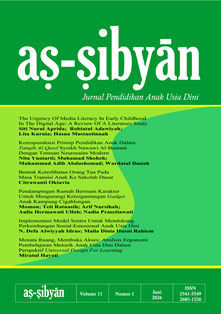
The Urgency of Media Literacy in Early Childhood in the Digital Age
A Review of a Literature Study
 DOI:
DOI:
https://doi.org/10.32678/assibyan.v11i1.11986
 Abstract viewed : 85 times
|
Abstract viewed : 85 times
|  pdf downloaded : 90 times
Keywords:
Media Literacy, Early Childhood, Digital Era, Literature StudiesAbstract
Massive exposure to digital media has created a complex environment for early childhood development, offering both learning opportunities and significant risks. In this context, media literacy emerges as a fundamental competency; however, gaps remain in developmentally appropriate implementation strategies and in building synergistic collaboration between parents and educators. This study aims to synthesize empirical evidence on the urgency of media literacy, implementation strategies, stakeholder roles, and challenges in fostering media literacy among children aged 0–8 years. Employing a systematic literature review guided by the PRISMA framework, this study analyzed peer-reviewed scientific articles published between 2019 and 2025. The findings reveal four major themes. First, media literacy functions as a form of “cognitive immunization” that supports the development of critical thinking, creativity, and digital resilience in early childhood. Second, parents and educators play a central role as key mediators, although their effectiveness is frequently constrained by a lack of alignment between practices in the home and school environments. Third, implementation strategies exist along a continuum, ranging from restrictive approaches to active mediation and empowerment through content creation. Fourth, systemic challenges persist, particularly the absence of formal curriculum integration and persistent inequities in access to digital resources. This study concludes that a paradigm shift from a passive, protective approach toward proactive empowerment is essential. The findings provide a strong conceptual foundation for policies and practices that integrate media literacy collaboratively and developmentally, to nurture critical and responsible digital citizens from an early age.
Downloads
References
American College of Pediatricians. (2020). Media Use and Screen Time - Its Impact on Children, Adolescents, and Families. . American College of Pediatricians.
Bastian, A. B. F. M., Imroatun, Muafiqoh, M., Zahra, S. H., & Sajid, D. I. B. (2023). Sikap Orang Tua dan Guru tentang Teknologi Digital Berbasis Media Aplication terhadap Perkembangan Bahasa Anak. Pratama Widya: Jurnal Pendidikan Anak Usia Dini, 8(2), 124–143. https://doi.org/10.25078/pw.v8i2.3116
Brock, L, L., Curby, & W, T. (2016). The role of children’s adaptability in classrooms characterized by low or high teacher emotional support consistency. School Psych. Rev., 45(2), 209–225.
Cahyani, I. R., & Fauziah, P. Y. (2024). Studi kualitatif peran orang tua dalam literasi dini di era digital. Jurnal Pendidikan Anak Usia Dini, 8(1), 45–56.
Creswell, J. W., & Poth, C. N. (2018). Qualitative inquiry & research design: Choosing among five approaches. SAGE Publications.
Erikson Institute. (2020). Media Literacy in Early Childhood Report. . Erikson Institute.
Fenwick-Smith, Dahlberg, E, E., Thompson, & C, S. (2018). Systematic review of resilience-enhancing, universal, primary school-based mental health promotion programs. BMC Psychol.
Gralczyk. (2019). Smartphone and tablet in the everyday life of preschool children. Impact and Educational Options in the Opinion of Parents and Teachers of Kindergarten. Social Communication, 20(2), 85–102.
Gualtieri, S., & Finn, A. S. (2022). The sweet spot: When children’s developing abilities, brains, and knowledge make them better learners than adults. Perspect. Psychol. Sci., 17(5), 1322–1338.
Hanemann, U., & Robinson, C. (2022). Rethinking literacy from a lifelong learning perspective in the context of the Sustainable Development Goals and the International Conference on Adult Education. Int. Rev. Educ., 68(2), 233–258.
Haywood, A., & Sembiante, S. (2023a). Media literacy education for parents: A systematic literature review. Journal of Media Literacy Education, 15(3), 79–92. https://doi.org/10.23860/JMLE-2023-15-3-7
Haywood, A., & Sembiante, S. (2023b). Media literacy education for parents: A systematic literature review. Journal of Media Literacy Education, 15(3), 79–92. https://doi.org/10.23860/JMLE-2023-15-3-7
Imroatun, I., Bastian, A. B. F. M., Imoy, S., Dea Pandini, F., & Setiawan Santoso, F. (2024). Pengenalan Literasi Keagamaan Melalui Metode Kreatif Dan Interaktif Untuk Anak Usia Dini. Ulumuddin: Jurnal Ilmu-Ilmu Keislaman, 14(2), 137–150. https://doi.org/10.47200/ULUMUDDIN.V14I2.2566
Lestari, A. D. P., & Antika, E. R. (2023). Self-Esteem and Peer Social Support: How Do They Contribute to High School Students’ Academic Hardiness? Pamomong: Journal of Islamic Educational Counseling, 4(2), 106–121. https://doi.org/10.18326/pamomong.v4i2.606
Livingstone, S. (2004). Media literacy and the challenge of new information and communication technologies. Communication Review, 7(1), 3–14. https://doi.org/10.1080/10714420490280152
Muharam, Mustikaati, Sanny, Yani, & Wiriyanti. (2021). The effect of using digital variety media on distance learning on increasing digital literacy. J. Phys. Conf. Ser.
Nikken, & Schols. (2015). How and why parents guide the media use of young children. J. Child Fam. Stud., 24(11), 3423–3435.
Nuffield Foundation. (2025). Early years digital media literacy review. Https://Www.Nuffieldfoundation.Org/Project/Early-Years-Digital-Media-Literacy-Review.
Rahmah, Huriyah, Mulyana, & Qonita. (2024). Peran Guru Dalam Perkembangan Literasi Pada Anak Usia Dini. Jurnal Pendidikan Guru Pendidikan Anak Usia Dini.
Sakhaei, Arsalani, & Nosraty. (2023). Media Literacy for Children : A Systematic Review. Journal Og Cyberspace Studies.
Sanz-Labrador, Cuerdo-Mir, Doncel-Pedrera, & M, L. (2021). The use of digital educational resources in times of COVID-19. Soc. Media Soc.
Sharples, M. (2023). Towards social generative AI for education: theory, practices and ethics.
Toh, Lim, & V, F. (2021). Let’s play together: ways of parent–child digital co-play for learning. Interact. Learn. Environ.
Turner-Zwinkels, F. M., & van Zomeren, M. (2021). Identity expression through collective action: How identification with a politicized group and its identity contents differently motivated identity-expressive collective action in the U.s. 2016 presidential elections. Pers. Soc. Psychol. Bull., 47(3), 499–513.
Ulfiya, F., Rinekasari, N. R., & Ningsih, M. P. (2021). Implementing web-based digital media in online courses. IOP Conf. Ser. Mater. Sci. Eng., 1098(2), 22111.
Downloads
Published
How to Cite
Issue
Section
License
Copyright (c) 2026 Siti Nurul Aprida, Robiatul Adawiyah, Lita Kurnia, Hasna Mustaotinnah

This work is licensed under a Creative Commons Attribution-ShareAlike 4.0 International License.


