
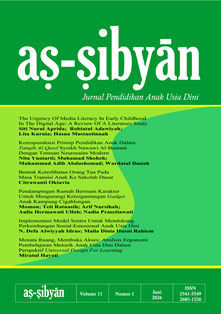
Korespondensi Prinsip Pendidikan Anak dalam Tanqih al-Qawl Syeikh Nawawi al-Bantani dengan Temuan Neurosains Modern
 DOI:
DOI:
https://doi.org/10.32678/assibyan.v11i1.12101
 Abstract viewed : 53 times
|
Abstract viewed : 53 times
|  pdf downloaded : 49 times
Keywords:
Child Education, Neuroscience, brain plasticity, Book AnalysisAbstract
The principle of Islamic education through manners and parental affection poses challenges in understanding the relevance of classical Islamic texts to children's brain development. This study aims to examine the child education in Chapter 31 of Kitab Tanqīḥ al-Qawl al-Ḥathīth fī Sharḥ Lubāb al-Ḥadīth by Sheikh Nawawi al-Bantani and to correlate them with contemporary neuroscience findings regarding executive functions, socio-emotional development, sensitive periods, and neuroplasticity. The research employs a qualitative literature-based approach, with primary data from Chapter 31 of Tanqih al-Qawl and secondary data from contemporary neuroscience literature. A descriptive-comparative analysis was conducted to map correspondences between classical educational principles and neurobiological mechanisms. The findings indicate that classical principles, prioritizing moral education, holistic care, staged learning, spiritual-social dimensions, and parental responsibility, align with the development of neural networks, the limbic system, executive functions, and reward circuits, highlighting opportunities for integrating classical Islamic education with neuroscience-based pedagogy.
Downloads
References
Al-Abrasyi, M. ’Athiyah. (1970). Dasar-dasar Pokok Pendidikan Islam. Bulan Bintang.
Al-Bantani, S. M. bin U. an-N. (n.d.). Terjemah Kitab Tanqihul Qoul.
Ansari, D. (2008). Effects of Development and Enculturation on Number Representation in the Brain. Nature Reviews Neuroscience, 9(4), 278–291. https://doi.org/10.1038/nrn2334
Azra, A. (2012). Pendidikan Islam: Tradisi dan Modernisasi di Tengah Tantangan Milenium III. Kencana (Prenadamedia).
Bandura, A. (1971). Social Learning Theory. General Learning Press. https://doi.org/10.4337/9781803928180.ch33
Bastian, A. B. F. M., Sajid, D. I. B., & Febriana, R. (2026). Pemaknaan Struktur Penalaran Moral Anak pada Hikayat Kalilah dan Dimnah. Asas Wa Tandhim: Jurnal Hukum, Pendidikan Dan Sosial Keagamaan, 5(1), 327–344. https://doi.org/10.47200/awtjhpsa.v5i1.3327
Blakemore, S. J., & Mills, K. L. (2014). Is adolescence a Sensitive Period for Sociocultural Processing? Annual Review of Psychology, 65(August 2013), 187–207. https://doi.org/10.1146/annurev-psych-010213-115202
Bloom, B. S., Engelhart, M. D., Furst, E. J., Hill, W. H., & Krathwohl, D. R. (1956). Taonomy of Educational Objectives: The Classification of Educational Goals. Longmans, Green and Co. Ltd. https://doi.org/10.1300/J104v03n01_03
Bucaille, M. (1977). The Bible, The Qur’an, and Science (Translation of La Bibble, le Coran et la Sience, 1976). Kazi Publications.
Coan, J. A. (2008). Toward a Neuroscience of Attachment (2nd Edition). In J. C. & P. R. S. (Eds.) (Ed.), Theory, research, and clinical applications (pp. 241–265). The Guilford Press.
Creswell, J. W., & Creswell, J. D. (2018). Research Design: Qualitative, Quantitative, and Mixed Methods Approaches (Fifth Edition). SAGE Publications. https://doi.org/10.4324/9780429469237
Davidson, R. J., & Lutz, A. (2008). Buddha’s Brain: Neuroplasticity and Meditation. IEEE Signal Processing Magazine, 176, 172–176. https://doi.org/10.1109/MSP.2008.4431873
Dewey, J. (1930). Democracy and Education. The Macmillan Company.
Diamond, A. (2013). Executive Functions. Annual Review of Psychology, 64(May), 135–168. https://doi.org/10.1146/annurev-psych-113011-143750
Erikson, E. H. (1950). Childhood and Society. W. W. Norton & Company.
Gardner, H. (1983). Frames of Mind: The Theory of Multiple Intelligences. Basic Books.
Goswami, U. (2008). Cognitive Development: The Learning Brain. Psychology Press Taylor & Francis Group.
Gutek, G. L. (2014). Philosophical, Ideological, and Theoretical Perspectives on Education (2nd edition) (Pearso, Ed.). Pearson Education.
Imroatun, I., & Ilzamudin, I. (2020). Sejarah Peristilahan Tarbiyah Dan Taklim Dalam Tinjauan Filsafat Pendidikan Islam. Ulumuddin : Jurnal Ilmu-Ilmu Keislaman, 10(2), 163–176. https://doi.org/10.47200/ulumuddin.v10i2.445
Knudsen, E. I. (2004). Sensitive Periods in the Development of the Brain and Behavior. Journal of Cognitive Neuroscience, 16(8), 1412–1425.
Kohlberg, L. (1981). The Philosophy of Moral development. Harper & Row. https://doi.org/10.1111/j.2044-8295.1982.tb01814.x
Magdalena, Endayana, B., Pulungan, A. I., Maimunah, & Dalimunthe, N. D. (2021). Metode Penelitian untuk Penulisan Laporan Penelitian dalam Ilmu Pendidikan Agama Islam. Literasiologi.
Montessori, M. (2020). The Discovery of the Child (The Montessori Method Volume 2). Montessori-Person Publishing Company.
Moriguchi, Y., & Hiraki, K. (2011). Longitudinal Development of Prefrontal Function during Early Childhood. Developmental Cognitive Neuroscience, 1(2), 153–162. https://doi.org/10.1016/j.dcn.2010.12.004
Nasr, S. H. (2008). The Garden of Truth: The Vision and Promise of Sufism, Islam’s Mystical Tradition. HarperCollins Publishers Inc. https://doi.org/10.5860/choice.45-3736
Piaget, J. (1952). The Origins of Intelligence in Children. In M. C. (Translator) (Ed.), Journal of Consulting Psychology. W. W. Norton & Company. https://doi.org/10.1037/h0051916
Reid, A. (2011). Asia Tenggara dalam Kurun Niaga 1450—1680: Jilid 2: Jaringan Perdagangan Global. Yayasan Obor Indonesia.
Shonkoff, J. P., & Phillips, D. A. (2000). From Neurons to Neighborhoods: The Science of Early Childhood Development. In From Neurons to Neighborhoods. https://doi.org/10.17226/9824
Skinner, B. F. (1953). Science and Human Behavior. Harvard University Press. https://doi.org/10.4135/9781483327372.n6
Suwarjin, S. (2017). Biografi Intelektual Syekh Nawawi Al-Bantani. Tsaqofah Dan Tarikh: Jurnal Kebudayaan Dan Sejarah Islam, 2(2), 189–202. https://doi.org/10.29300/ttjksi.v2i2.717
Tottenham, N. (2015). Social Scaffolding of Human Amygdala-mPFCcircuit Development. Social Neuroscience, 10(5), 489–499. https://doi.org/10.1080/17470919.2015.1087424
Vygotsky, L. S. (1978). Mind in Society: The Development of Higher Mental Processes. Harvard University Press.
Zed, M. (2008). Metode Penelitian Kepustakaan. Yayasan Obor Indonesia.
Downloads
Published
How to Cite
Issue
Section
License
Copyright (c) 2026 Nita Yuniarti, Muhamad Shoheh, Muhammad Adib Abdushomad, Wardatul Ilmiah

This work is licensed under a Creative Commons Attribution-ShareAlike 4.0 International License.


