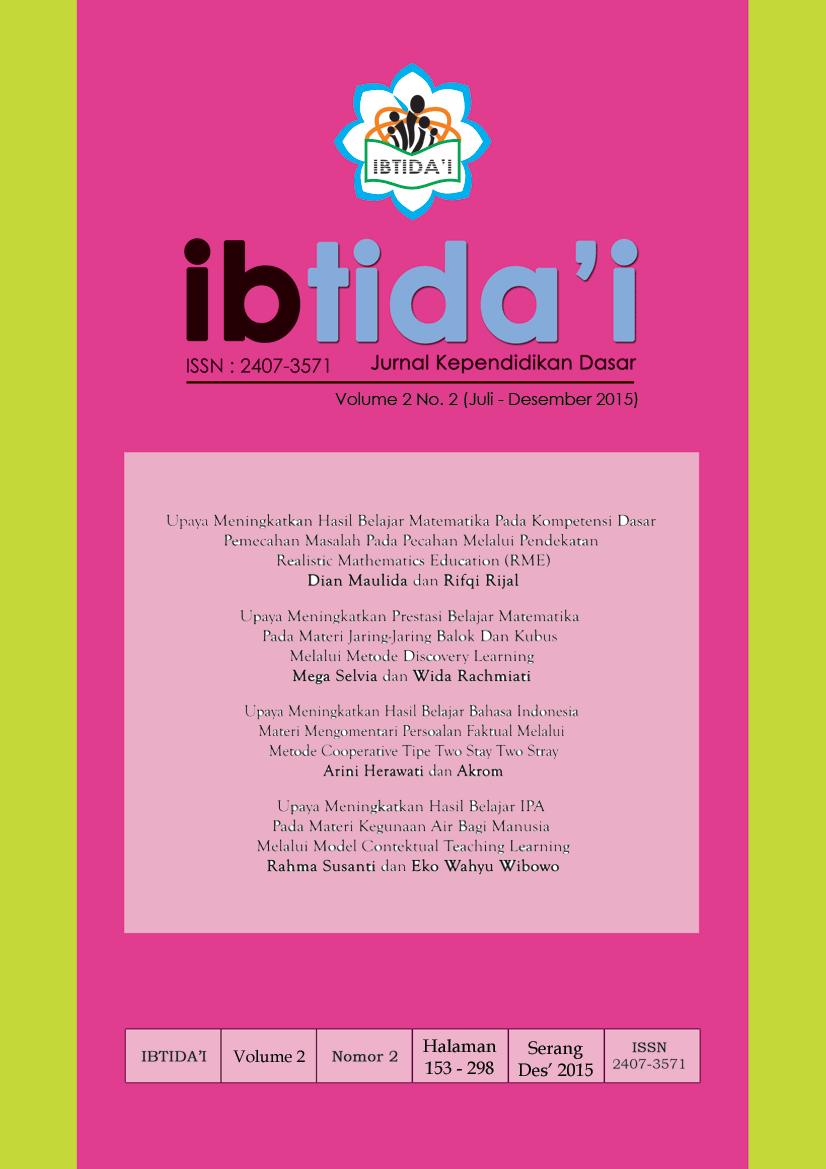
UPAYA MENINGKATKAN HASIL BELAJAR IPA PADA MATERI KEGUNAAN AIR BAGI MANUSIA MELALUI MODEL CONTEKTUAL TEACHING LEARNING
 Abstract viewed : 276 times
|
Abstract viewed : 276 times
|  PDF downloaded : 114 times
Keywords:
Model, Contextual Teaching Learning, IPA, Keguanan air bagi manusiaAbstract
Penelitian ini dilatar belakangi oleh kesulitan siswa dalam mengikuti pelajaran IPA di kelas V hal ini dapat dilihat dari hasil pengamatan yang dilakukan peneliti yaitu pembelajaran masih berpusat pada guru, sehingga siswa hanya menerima informasi langsung dari guru dan kurang mendapatkan kesempatan untuk lebih aktif dalam pembelajaran, sehingga menyebabkan hasil belajar siswa rendah. Penelitian ini bertujuan untuk mengetahui peningkatan aktivitas belajar siswa pada mata pelajaran IPA pada materi kegunaan air bagi manusia di kelas V SDN2 Penggalang dengan menggunakan model Contektual Teaching Learning (CTL). Hasil penelitian tindakan kelas dapat di simpulkan sebagai berikut: Hasil belajar siswa dilihat dari nilai rata-rata pra siklus sebelum menggunakan model pembelajaran CTL sebesar 48,12 dengan persentase ketuntasan 12,5%, siklus I setelah menggunakan model CTL meningkat menjadi 53,13 dengan persentase ketuntasan 37,5% dan siklus II meningkat menjadi 77,19 dengan persentase ketuntasan 87,5%. Sedangkan untuk aktivitas siswa dalam pembelajaran menggunakan CTL aktivitas lebih aktif dan efektif dalam proses pembelajaran berlangsung. Hal ini dapat dilihat pada tabel aktivitas siswa yang mengalami peningkatan pada siklus I yaitu 75 % atau masuk ke kategori baik dan mengalami peningkatan pada siklus II yaitu 90% atau ke kategori sangat baik. Selain terjadi peningkatan pada aktivitas siswa, aktivitas guru mengalami peningkatan hal ini terlihat pada siklus I yaitu memperoleh 70,6% dan pada siklus II memperoleh 94,12%.Downloads
Downloads
Published
How to Cite
Issue
Section
License
Ibtida'i: Jurnal Kependidikan Dasar https://ftk.uinbanten.ac.id/journals/index.php/ibtidai is licensed under a Creative Commons Attribution–NonCommercial 4.0 International License (CC BY-NC 4.0).
By submitting and publishing an article in Ibtida'i: Jurnal Kependidikan Dasar, the author(s) agree to the following terms:
-
Copyright Ownership
The author(s) retain the copyright of the published work and grant Ibtida'i: Jurnal Kependidikan Dasar the right of first publication. -
License Grant
The published work is simultaneously licensed under the Creative Commons Attribution–NonCommercial 4.0 International License (CC BY-NC 4.0). This license permits others to:-
copy, distribute, display, and perform the work;
-
adapt and build upon the work;
for non-commercial purposes only,
provided that appropriate credit is given to the author(s) and the original publication in this journal.
-
-
Restriction on Commercial Use
Any use of the published work for commercial purposes is not permitted without prior written consent from the author(s). -
Non-Exclusive Distribution Rights
The author(s) may enter into separate, additional contractual arrangements for the non-exclusive distribution of the journal's published version of the work (for example, depositing it in an institutional repository, publishing it in a book, or other scholarly platforms), provided that the original publication in Ibtida'i: Jurnal Kependidikan Dasar is properly acknowledged. -
Self-Archiving and Online Posting
The author(s) are permitted and encouraged to post their work online (e.g., in institutional repositories, personal websites, or academic networking sites) before and during the submission process, as well as after publication. This practice is expected to foster academic exchange and may increase the visibility and citation of the published work.
More information about the Creative Commons Attribution–NonCommercial 4.0 International License is available at: https://creativecommons.org/licenses/by-nc/4.0/
The names and email addresses entered on this journal site will be used exclusively for the stated purposes of Ibtida'i: Jurnal Kependidikan Dasar. They will not be made available for any other purpose or disclosed to any other party without the users' explicit consent.